




Bali and the peaceful unease
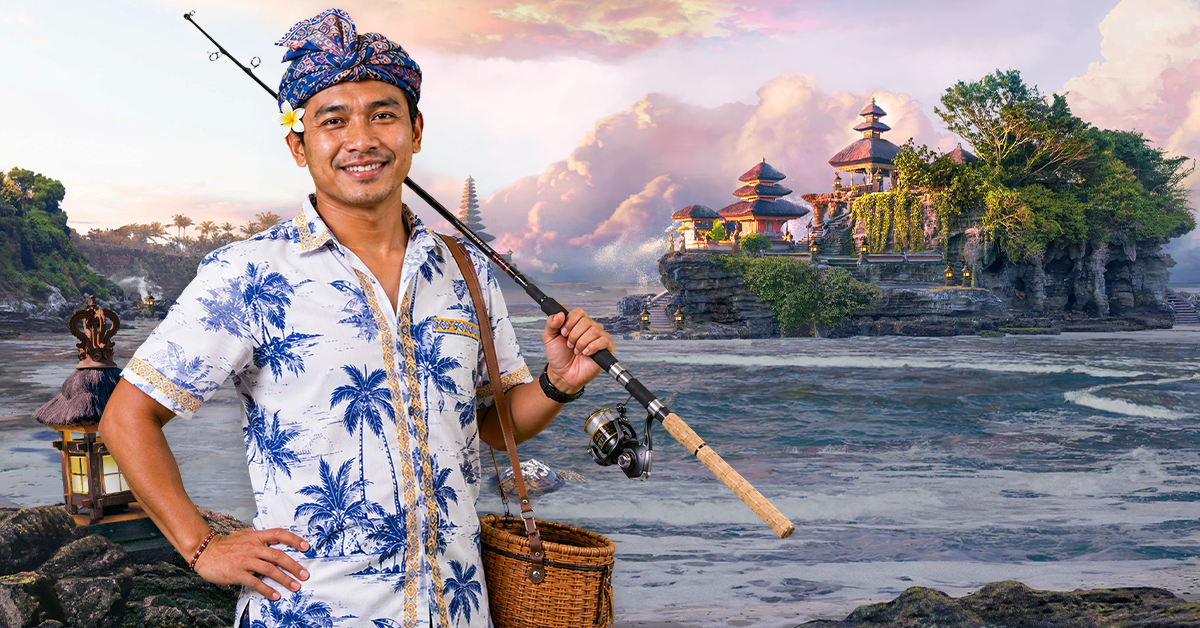
In our fishing journey around the globe, we’re anchoring in Bali, one of the most famous islands in Indonesia. Bali is a popular tourist destination, a place of potential self-discovery, and the must-have pretty view on one’s social media feed. As Anglers of great passion, we’re visiting Bali for the depths, not just the vibes, so in today’s article, we’ll explore peace and serenity, the island’s most sought-after commodities, but with our usual twist: what makes them so difficult to attain? Sit back (not necessarily in the lotus position), grab a drink (it doesn’t have to be a matcha latte), and enjoy the read (hopefully!).
An island of practice
Beyond its abundance of leisure activities, Bali is also known as a popular destination for the spiritually inclined, for people in the process of any kind of soul-searching, whether through meditation practices, prayer, guided yoga sessions, or everything in between. Some come here to find themselves, their true self, while others seek to deepen the relationship they already have with the divine and to expand their ongoing spiritual practices. Bali appears to be an excellent backdrop for all of that and so much more. The island’s tropical climate is already a unique substrate for spiritual growth, especially if you’re visiting from elsewhere in the world. The magnificent views of lush forests and picturesque beaches, the hot and humid air, and the spirituality that’s already ingrained there all seem like the excellent next step on the path toward the sacred. And for good reason, too.
Bali’s spirituality isn’t just a concept elevated through marketing and social media filters. Balinese Hinduism is woven into the island’s everyday life. There are temples everywhere, from famous sea sites and mountain sanctuaries to village and family shrines; small offerings are placed daily in doorways and streets. This is why Bali is often called the Island of the Gods, or the Island of a Thousand Temples. Even as parts of the island become increasingly shaped by tourism and Western expectations, its local traditions remain visible, practiced, and deeply rooted – unlikely to disappear, in contrast to Instagram trends, which often fade away as quickly and unexpectedly as they emerge.
Today, however, we’re diving deeper into a specific piece of not just the spiritual journey or the various vacation trips we take, but something we’re familiar with as fishing enthusiasts: peace of mind. A goal to attain for some, an everyday crutch to lean on for others, and an impossibility for quite a few. So, let’s take a quiet stroll around the island of serenity. Maybe we’ll discover why the place isn’t always so crowded these days…?

Peace? But we have peace at home!
First, it’s important to say that attaining absolute, everlasting peace is an illusion. Chasing it is a fool’s errand. Granted, one that might at least occupy us for a time, so it has some usefulness. But life, at its essence, requires some tension, as without it, things would fall apart, and there would be no room for growth. Peace also doesn’t exist in a vacuum, but in the context of our busy lives. The best we can do, when it comes to peace as such, is to reach a place where there’s no internal tension. A state possible to attain, indeed, but one that needs work prior to it and management afterward. Not something we can get to overnight, and definitely something that won’t stick around just because we want it to.
Mindfulness teacher Jon Kabat-Zinn titled one of his books Wherever You Go, There You Are quite brilliantly. In that title alone, this American professor emeritus of medicine suggests that we cannot separate ourselves from the challenges we face. We may change jobs, replace old relationships with new ones, embark on a spiritual journey to Bali, India, or a mountaintop monastery, but our difficulties will be there, awaiting us in different forms, ready to be faced. No amount of scented candles, yoga mats, or spiritual gurus will absolve us from taking the first, most important step: taking responsibility. We are responsible for the very texture of our minds, the way we speak to ourselves, and how we interact with the world at large. Ultimately, the internal work needs to be done by us, since there’s no one else who knows us as well as we do.
“Know thyself,” the ancient Greek maxim, may very well be the most compact way to describe the path toward peace. Carl Gustav Jung, the Swiss psychiatrist, psychotherapist, and psychologist, who founded the school of analytical psychology, once said, “Until you make the unconscious conscious, it will direct your life and you will call it fate.” Meanwhile, the contemporary executive coach, Joe Hudson, states, “Knowing yourself is the only safety.” All true, yet nothing comes without effort. But are there any roadblocks that stop us from attaining peace? (Outside all the ones imaginable?)
Peace of mind, heart, and gut
While we can intellectually grasp that peace can be useful, and that resting is a crucial element to any activity and growth, there’s a big mental barricade to overcome: the persistent feeling that there are still things requiring our attention. There’s still so much to be done! And, indeed, this sense is deeply rooted in today’s competitive world. We’re creatures of comparison, after all. Not just culturally and socially, but neurologically: mirror neurons lie at the core of our ability to learn from others, imitate their actions, and empathize with their experiences – the very heart of what makes us human. While a useful mechanism in itself, in our modern world it impressively backfires.
When thinking of anything that troubles us nowadays, we should keep in mind our hunter-gatherer roots. It was under these conditions that we evolved, and this way of life constituted over 95% of human history. When living in small communities back in pre-civilization days, we had very little to compare to. Such communities rarely exceeded 50 individuals, although they were parts of larger, fluid, regional networks. We could see someone better at hunting or basket weaving in the neighboring group of nomads and wanted to learn their technique, but that was just about it when it comes to comparison and the extent of our ambition. Achieving that level was definitely within our reach. Nowadays, we’re bombarded with images of others living a supposedly more fulfilling, exciting, and amazing lives. How can we rest with this huge fear of missing out? The answer is simple: graciously.
Since comparing ourselves to others isn’t very useful, it’s best to abandon it altogether. Yes, easier said than done, so we must do it in small increments, step by step. Identifying our habits is a good way to start. Dialing down on social media, the modern scourge of comparison, is also pretty helpful. Finally, observing our thoughts, the mindfulness approach, can go a long way. And, if we must compare (because, let’s be real, it will happen anyway), let’s take ourselves as the point of comparison. Are we growing? Are we doing better than before? Are we learning from our mistakes? The answers will usually be yes, so it’s worth to hold on to that.
When it comes to peace, there’s also a kind of moral difficulty to overcome. How can we relax when there’s unease in the world? This one isn’t easy to grok, but if our moral compass is that strong, perhaps we can benefit from understanding that the way we appear has a tangible effect on the world around us. Not globally, but definitely in the relations with our loved ones: family, friends, and colleagues. People from our closest circles. If we let ourselves rest, relax, and experience some peace of mind, it will have a rippling effect. It may not save the whole world, but change always starts with ourselves.
Finally, sometimes our bodies stand in the way of us relaxing. A strained nervous system doesn’t calm down easily, especially after prolonged stress. There are a thousand ways of calming it down; in this day and age, we can pick and choose the ones that work well for us. The pitfall here is treating relaxation or the pursuit of peace as yet another chore – another version of a “stupid” walk for our “stupid” mental health. If there’s a chance it may become that, it’s best to rethink our priorities and perhaps declutter our lives a bit. Our beloved activities, including playing Fishing Clash, will await us once we find a moment’s peace. But perhaps checking out the new Bali fishing spot in the game is just the relaxation we need? In the end, it’s up to us to find out!